
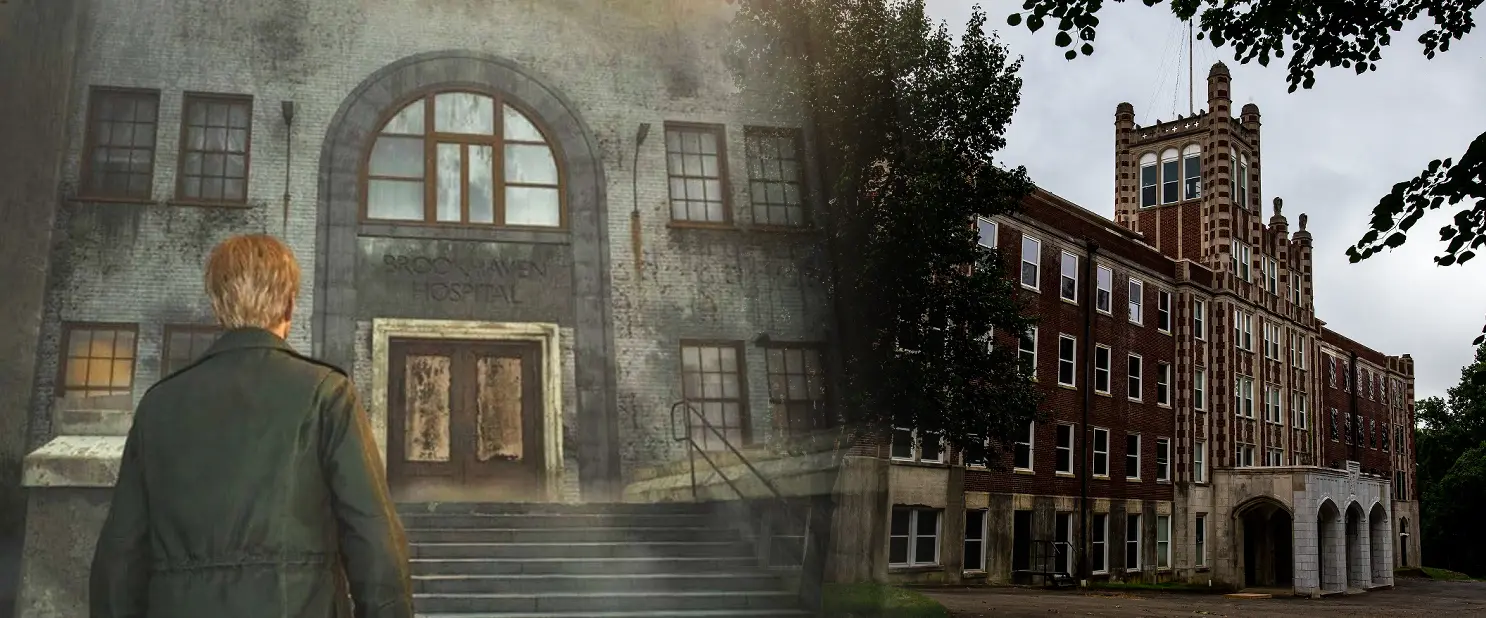
Game developers and writers have a lot on their hands to ensure players are immersed in their game, from RPGs like Dark Souls to other games like Death Stranding and Fallout. Each one uses different inspirations to create environments and atmospheres that pull us in.
Horror games are no exception. Which is why today I want to talk about 2 hospital horror game settings and their real-life inspirations.
I’ve always found something interesting about games that pull from real history, mythology, or actual locations. Even if those places aren’t somewhere you could realistically visit, seeing them used as inspiration makes them feel a bit closer.
Like they’re still within reach in some way.
And that plays a big part in how the atmosphere works, especially when it comes to hospitals, and even more so psychiatric ones.
Let’s start with one of the most well-known examples, shall we?
Table of Contents

1. Mount Massive Asylum, Outlast
Real-life inspiration: Richardson Olmsted Complex, USA.
Set in the distant mountains of Colorado is Mount Massive Asylum, the psychiatric hospital from Outlast. The game takes place inside the facility after journalist Miles Upshur breaks in to investigate the Murkoff Corporation, following a tip about illegal experiments being carried out on patients.
As a hospital horror game, Outlast focuses heavily on navigating the building itself. The layout includes long corridors, multiple wards, administrative offices, and restricted sections, including underground areas. Much of the gameplay involves moving through these parts of the hospital while avoiding former patients.
Although Mount Massive Asylum is a fictional location, its visual and structural design closely echo the Richardson Olmsted Complex, formerly the Buffalo State Asylum for the Insane.
The Richardson Olmsted Complex was designed in the late 19th century by architect Henry Hobson Richardson, with landscape design by Frederick Law Olmsted and Calvert Vaux. The building follows the Kirkbride Plan, an architectural approach used for psychiatric hospitals at the time.
This design is built around a central administrative building with long, staggered wings extending outwards. Patients were separated based on condition, with more severe cases placed further away from the centre. The goal was to provide structure, supervision, and controlled movement throughout the hospital.
That same approach can be seen in Outlast. As you move deeper into Mount Massive Asylum, areas become more restricted and segmented, shifting from administrative spaces into controlled wards and secured sections. The game does not recreate the Richardson Olmsted Complex exactly, but the overall structure and layout follow the same principles.
Red Barrels, the developers of Outlast, publicly acknowledged the similarity between Mount Massive Asylum and the Buffalo Psychiatric building, describing the resemblance as “striking.” Because of this, the Richardson Olmsted Complex stands out as one of the clearest real-world references behind this hospital horror game setting.

2. Volterra Psychiatric Hospital, The Town of Light
Real location: Ospedale Psichiatrico di Volterra (Italy)
Volterra Psychiatric Asylum is the central setting of The Town of Light, a hospital horror game that takes a very different approach compared to most others in the genre. Instead of focusing on combat or jump scares, the game is built around exploration and real historical context.
The game is set inside the Ospedale Psichiatrico di Volterra, a real psychiatric hospital that operated from the late 1800s until its closure in 1978.
Developers LKA used the actual location as the foundation for the game, recreating parts of the building based on real layouts and archival research. The story itself is fictional, but it is grounded in documented practices and conditions from Italian psychiatric institutions during that period.
At its peak, the Volterra asylum housed several thousand patients, making it one of the largest psychiatric hospitals in Italy. Like many institutions of its time, it became overcrowded, and patients were often admitted for reasons that would not be considered valid today.
Historical records from Italian asylums, including Volterra, document the use of treatments such as electroconvulsive therapy, insulin shock therapy, and physical restraints. These practices were widely used across Europe during the early to mid-20th century.
One of the most well-known figures connected to the hospital is Fernando Oreste Nannetti, a patient who carved drawings and text into the asylum walls using the metal buckle from his belt. His work, often referred to as a “graffiti book”, stretches for around 180 metres along the walls of the Ferri pavilion and records his thoughts, memories, and imagined experiences.
The hospital closed in 1978 following psychiatric reforms introduced by Italian psychiatrist Franco Basaglia, which led to the closure of large asylums across Italy and a shift towards community-based mental health care.
Unlike many hospital horror games, The Town of Light does not just take visual inspiration from the real location. Parts of the hospital are recreated based on the actual building, and the game draws from documented practices and patient experiences. While the main story is fictional, it reflects real conditions recorded in institutions like Volterra during that time

Final Thoughts…
I wanted to focus on hospital horror game settings that have a clear link to real places, rather than relying on speculation or loose comparisons.
Looking at Mount Massive and Volterra, you can see where those links are. One drawing from architectural design, the other built directly on a real location and its history.
And when you’re walking through those corridors, you’re not just moving through something designed to be unsettling.
In some ways, you’re walking through history.
FAQs on Hospital Horror Game Settings
Are there books or documentaries about the Buffalo State Asylum for the Insane?
Yes, the Richardson Olmsted Complex has been covered in architectural studies, historical books, and documentaries. These typically focus on the Kirkbride Plan, the design of the building, and the history of psychiatric care in the 19th century.
Where can you find historical photos of the Buffalo State Asylum?
There are plenty of historical photos available online, not just in physical archives. Good places to look include:
– The Richardson Olmsted Complex official website (they have historical galleries)
– Library of Congress digital collections
– University and local Buffalo archives
– Historic American Buildings Survey (HABS)
Can you visit the Volterra Psychiatric Hospital today?
Parts of the Volterra Psychiatric Hospital are still standing, but most of the site is abandoned and access is restricted.
Guided tours have been organised at times, usually focusing on the history of the hospital and its role before psychiatric reforms in Italy. Availability changes, so it’s best to check local tourism sites or heritage listings in Volterra before visiting.
Leave a Reply